
Recently, I asked my LinkedIn audience a simple question:
Which skill will be most important for professional success over the next five years?
I gave four options: Digital Literacy, Emotional Intelligence, Critical Thinking, and Creativity & Innovation.
The question was simple, but the responses and conversations that followed were much more interesting.
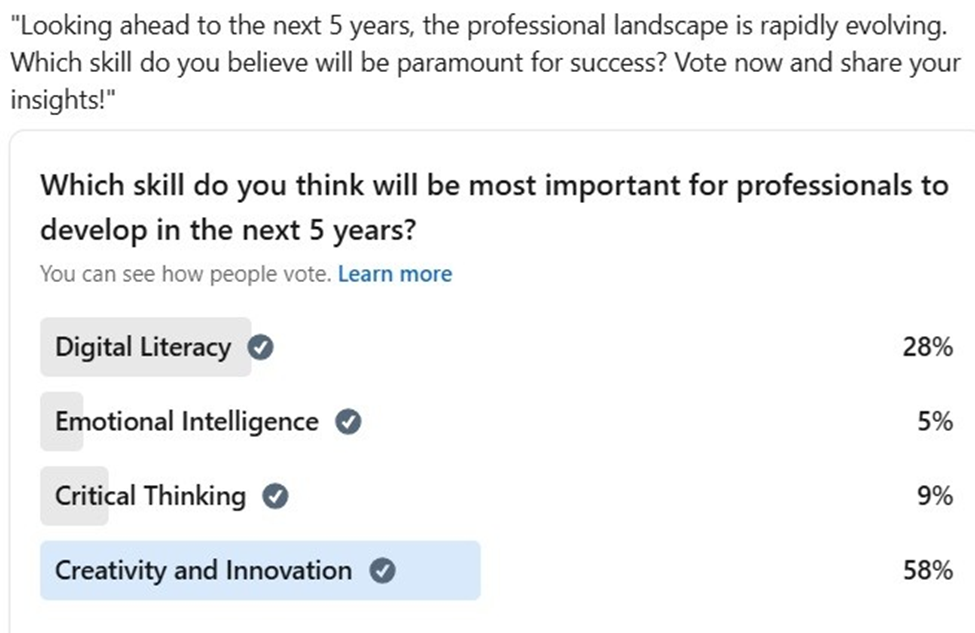
Thank you to everyone who took the time to participate, vote, and share their perspective. What I found most valuable was not simply which option received attention, but the different ways people think about success in a workplace that is changing so quickly.
As an HR professional, I naturally look at this question from a talent and leadership perspective.
After reflecting on the responses and based on what I have observed throughout my career, I believe Digital Literacy and Creativity & Innovation will become two of the most critical differentiators for professionals over the next five years.
But there is an important point behind that statement. I do not believe the future belongs to people who simply know how to use technology. And I do not believe it belongs only to people who are naturally creative. I believe the real advantage will come from people who can combine technology with human thinking.
Digital Literacy Is No Longer an Extra Skill
There was a time when being comfortable with technology could make someone stand out. Today, it is becoming part of the basic expectations of professional life. When I think about my own HR journey, the change is very visible. HR used to be heavily dependent on paper, spreadsheets, manual records and time-consuming administrative processes. Today, HR professionals are working with HRIS platforms, digital dashboards, employee data, online learning systems, engagement tools, digital recruitment platforms and AI-supported solutions.
The transformation is not only about replacing manual work with software. It is changing how we think. A modern HR professional is expected not only to produce a report, but to understand the story behind the numbers.
For example, if employee turnover increases in one department, digital literacy allows us to access and analyses the data. But the real value comes when we can ask:
Why is this happening?
Is it leadership?
Workload?
Career opportunities?
Compensation?
Engagement?
Or something that the numbers alone cannot explain? That is why I see digital literacy as much more than knowing how to operate digital tools. It is the ability to work intelligently in a digital environment.
But Technology Alone Cannot Create the Future
This is where Creativity & Innovation become so important. Technology gives us tools.
Creativity gives us possibilities.
I have always believed that some of the best improvements in an organization start with a very simple question:
“Why are we doing it this way?”
That question can be uncomfortable.
Every organization develops its own processes over time. Some are necessary, some become routine, and some simply continue because no one has stopped to question whether there is a better way. In my experience, some of the most meaningful improvements have come from employees who were willing to look at familiar problems from a different perspective.
Innovation does not always mean introducing something completely new or revolutionary. In HR, it can be as simple as improving the onboarding experience so a new employee feels welcomed and connected from the very beginning. It can mean finding a more effective way to identify and develop future leaders, using technology to reduce administrative work so HR can focus more on people, or creating learning opportunities that employees genuinely find useful and engaging.
Sometimes innovation is big.
Very often, it is simply doing something better than yesterday.
The Real Power Comes From Combining the Two
This is probably the biggest lesson I take from the discussion.
Imagine two professionals.
One is highly comfortable with digital tools but simply follows whatever the technology tells them. The other is very creative but struggles to use modern tools effectively. Both have strengths.
But imagine a third professional—someone who can understand technology, use data, ask better questions, challenge assumptions and turn ideas into practical solutions. That combination is powerful.

And I believe that is where the future is heading. We are already seeing this with Artificial Intelligence. AI can help us analyses information, generate ideas, automate repetitive work and improve productivity. But the quality of the outcome still depends heavily on the person using it.
A poor question can produce a poor answer. A better question can create a completely different outcome. So, perhaps the most valuable skill is not simply knowing how to use AI.
It is knowing what to ask, what to trust, what to challenge and how to turn the result into action. Where Do Emotional Intelligence and Critical Thinking Fit?
This is where I would be careful about calling one skill “the winner.” As an HR leader, I believe Emotional Intelligence and Critical Thinking will remain fundamental.
In fact, the more technology develops, the more important some human capabilities may become.
Technology can process data, analyse information, and support faster decision-making, but it cannot replace human empathy, emotional intelligence, and judgement. When an employee is struggling, understanding their emotions and personal circumstances still requires a human approach.
Technology can support leadership, but building trust, managing workplace conflict, and making difficult people decisions require human judgement and emotional intelligence. As access to information and AI-powered tools continues to grow, Critical Thinking will become even more important. Professionals will need to evaluate information carefully, identify what is reliable, and make thoughtful decisions rather than simply accepting what technology produces.
The real question will be:
Can you determine what is useful, what is accurate, and what actually matters?
For me, that is where Critical Thinking becomes a powerful companion to Digital Literacy.
What Should Professionals Do Now?
My advice is quite simple.
Do not wait until your organization tells you that you need a new skill. Start developing it before it becomes a requirement. Learn the digital tools relevant to your profession.
Understand data.
Experiment with AI.
Read outside your immediate area of expertise.
Ask more questions.
Challenge old ways of working.
And most importantly, do not become so focused on technology that you forget the people around you. The best future leaders will not be those who choose between technology and people. They will be the ones who know how to bring the two together.
My Takeaway
The discussion with my LinkedIn audience made me reflect on something I have seen repeatedly throughout my HR career:
The people who remain valuable are rarely the ones who simply know the most. They are the ones who continue to learn, adapt and create value as the environment changes.
Five years from now, many of the tools we use today may look completely different.
Some jobs will change.
Some processes will disappear.
New roles will emerge.
But the ability to learn, think, adapt and create will remain. So, rather than asking, “Which skill should I develop?”, perhaps we should ask a more important question:
“Am I developing fast enough for the future I am going to work in?”
That, in my view, is the real question for every professional—and every organization preparing for the next five years.
Test Your Knowledge
Think you got the key points? Take the quick quiz and see how much you remember.