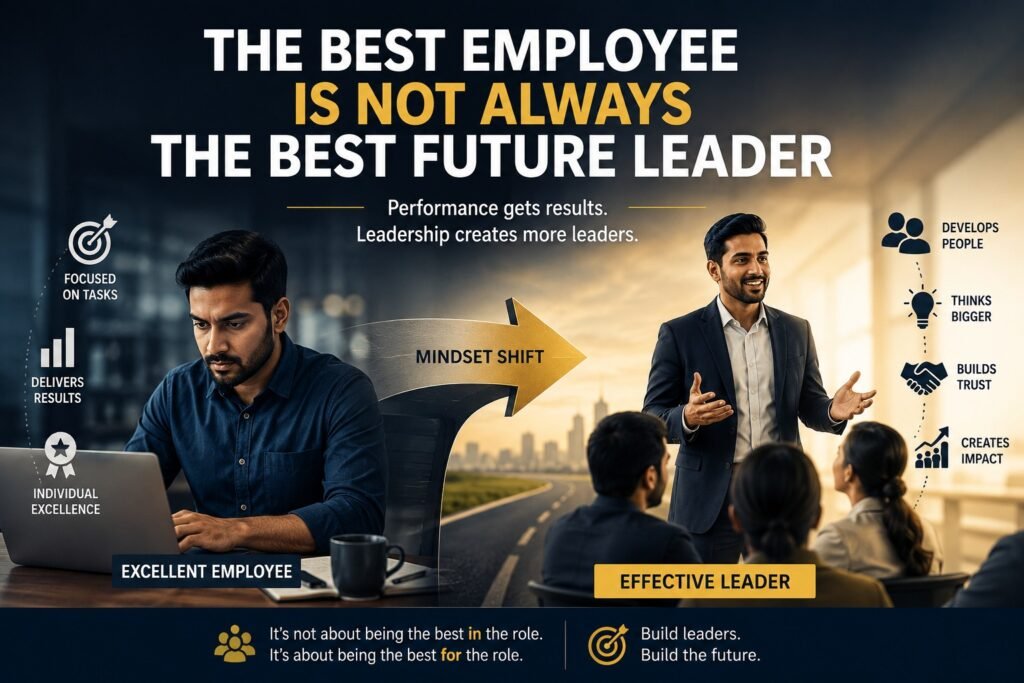
One of the most common mistakes organizations make when identifying a future leader is assuming that their best-performing employee will automatically become the best person to lead others.
I have seen this happen many times throughout my HR career.
Someone consistently delivers excellent results, understands the operation inside out, solves problems quickly and becomes the person everyone depends on. Naturally, the next step seems obvious: promote them into a leadership role. But strong performance does not always mean leadership potential, and this is where things can become complicated.
Because being an excellent individual contributor and being an effective leader are two very different things.
Being Good at Your Job Is Not the Same as Leading Others
Imagine a restaurant with an outstanding chef.
He knows the operation better than almost anyone. His technical skills are excellent. He is fast, disciplined and consistently delivers quality. So, he is promoted to lead the entire kitchen. A few months later, problems begin.
He becomes frustrated when others do not work as fast as he does. Instead of coaching people, he takes over their tasks. He struggles to delegate. He expects everyone to think the way he does. The team’s performance starts declining, even though his own technical ability remains excellent.
What happened?
Nothing happened to his technical capability.
The role changed, but his mindset did not. Leadership requires a different way of thinking. When you are an individual contributor, your focus is often on “How can I do this well?”
When you become a leader, the question changes to: “How can I help others do this well?”
That is a completely different responsibility.
Leaders Have to Think Beyond Their Own Results
One of the biggest shifts I look for when assessing future leaders is whether someone can move from an individual perspective to a broader organizational perspective.
A strong employee may say:
“I completed my target.”
A future leader asks: “Did my team achieve the right outcome, and what do we need to do differently next time?”
The first is focused on performance.
The second is beginning to think about leadership.
Leaders need to think beyond today’s task, today’s problem and sometimes even today’s business result. They need to understand the bigger picture—people, customers, financial performance, culture, succession, reputation and what the organization may need six months or two years from now.
That requires vision.
Leadership Also Requires Letting Go
This is one of the hardest lessons for high performers. People who become successful because they are excellent at doing things themselves can struggle when they have to stop doing everything themselves. I remember seeing this with a high-performing professional who was promoted into a supervisory role. Whenever the team faced a problem, he immediately stepped in and fixed it.
Initially, everyone appreciated him. But over time, something became obvious: the team was becoming dependent on him.
He was solving problems, but he was not developing people who could solve those problems without him. That is the difference between being the person who gets the job done and being the leader who builds a team capable of getting the job done.
Leadership is not about becoming the most important person in the room. It is about making the people in the room better.
Potential Is More Than Performance
When I look at future leaders, I therefore look beyond current performance.
How they respond to feedback can reveal their openness to learning.
The way they handle disagreement can show their maturity and respect for different perspectives.
Taking responsibility, especially when things go wrong, is another important sign.
There also needs to be an ability to see beyond one’s own department and understand the wider organizational picture.
A genuine interest in developing and supporting others matters just as much as individual achievement.
Curiosity is another strong indicator. People with leadership potential tend to ask questions, seek understanding and remain open to learning.
Then there is decision-making. Leadership often means making thoughtful choices even when complete information is unavailable.
And perhaps most importantly, there must be enough maturity to understand that leadership is not about having more authority—it is about having greater accountability.
Not every excellent employee wants to be a leader, and that is perfectly fine. Some of the best professionals are outstanding specialists, experts and individual contributors. Organizations need them too. But when we decide someone is ready for leadership, we should ask a different question:
Are they ready to think bigger, not simply perform better?
Because the best employee may be the person who consistently delivers the result.
The best future leader is often the person who can create the conditions for others to deliver the result.
That distinction can make all the difference.
Test Your Knowledge
Think you got the key points? Take the quick quiz and see how much you remember.